The Tanat Valley

When I decided to “paddle to and sleep on 77 islands” I knew that at least one island would be here, in “our bit” of Wales, in the beautiful Tanat Valley. I had one particular muddle of islands in mind.

Looking down on the islands in winter from the woods.
Every time I walk or paddle there these islands are different. In flood the river carves out a newly drawn map of islands banked in by slatey pebbles. Every winter new channels are driven through. Winter rains bring a deluge load of fallen trees and brush, fence poles, tangled wires and silage wrappers form tangled dams that shred the water.
Why just here? On each side of the islands the river is peaceable and law abiding. Were all rivers once as untamed?

This was not always “our bit” of anywhere. In the Summer of 1990, 36 years ago, we moved to a Welsh longhouse called Tan Y Graig in a hamlet called Bwlchyddar at the very northernmost edge of Mid Wales. Loosely translated that is “The house (or the hearth) under the rock” in the hamlet of “the Pass with the Oak trees”. We’re at 1020 feet on the side of a hill called Hen Allt, the Old Hill, which rises to 1230 feet.

Tan y Graig nudged in to the side of Hen Allt, Coed Comed behind
The mile long ridge of Hen Allt looks out on one side to Tanat Valley leading your eye up to the ridge line of the Berwyn Mountains and on the other side to the flat lands where the little River Cain draws a slender line to join the Vyrnwy which in turn joins the Severn. At one time or another I’ve paddled them all. Beyond the confluence of the Vyrnwy and the Severn lie the Shropshire Plains and the Shropshire Hills.

Hen Allt with Poppy and Morgan, photographed by Jack Goolden. We get a new version of this photo every year, marking the grand children's childhood
In Winter we come up here to assess the extent of flooding on the Severn by the spread of the silvery lakes and loops below us. On the Millennium Eve we saw bonfires as far away as Liverpool. In Summer you can rotate on your heels on a clear day to see the beautiful rise of Aran, at the end of Llyn Tegid, Cadair Idris, the Plynlimon Hills and the glint of the wind farm at Caersws.

Poppy and Eve, photo by Jack
We found ourselves the owners, or maybe guardians of 9.9 acres of thin upland soil running from the house to almost the top of Hen Allt. How could we “own” such a place? We don’t have the heritage: we’re townies, English, Southerners.
We had never envisaged such a move. My partner Col was the higher wage earner of us and his work brought us here. My Dad, who was a farmer visited just once before he died. He was already suffering from untreated and undeclared cancer.
He drove up our “impossible” track, looked around him briefly and then drove back to find the nearest farm supply store. He brought us a pickaxe. He said “You’ll need this.” And then “Someone’s kept pigs here.” How did he know that? “Pigs. Once. But there’s no point. Pigs have to have something to dig for and there’s nothing under that lot. Except rocks.”
Pigs were his favourite farm animal after Shire Horses. He shot a fierce warning look to me “And don’t think you can keep pigs as a pet.”
He didn’t make any further comment, or at least not to us.
Aunt Mary did. At a family gathering some months later she told me we had clearly brought rubbish land which was a disgrace to a good Bedfordshire family of prize-winning farmers and growers. Sheep weren’t their thing. Grandfer Issac would have turned in his grave. He was a formidable judge of land and people, grew as good a tomato or chrysanthemum as you could find. He had rosettes to show for it. And he was grumpy fellow.
We loved it. We’d never wanted to be farmers anyway. Right from the start we loved our “impossible” track, we loved our bit of hill, the cowslips in spring and harebells in the thin grass in late summer, the very flowers that for Mary marked our land as poor. We even loved the rain.


That I could be so lucky as to live up an impossible track lined with delicate stitchwort

Amy and Col on track work 1991 The Citroen, a classic mark of incomers, was donated to one of Amy's friends years later and ended up painted mauve with flowers all over.
36 years ago, our first morning, I woke up on and listened to the silence and breathed in the impossibly sweet air. It felt like a gift, an improbable dream, as if we were here on an undeserved holiday. It still does.

A wealth of self sown Welsh Poppies herald spring. Photo by Jack
We’ll never be “of” this land. We’ll never belong. I’ve lived here in Wales longer than I’ve ever lived anywhere. Twice as long. Half my life. But I’ll never for one moment think I’m Welsh. I deeply love Wales and admire a certain distinct quality in my Welsh friends and neighbours that I won’t attempt to pin down.
We’re still blowins.
We have, however, changed a little bit of the landscape.
From November 1996 to March 1997 we planted a wood with a Forestry Commission Grant. Every weekend that cold winter we spent every waking hour planting. It was hard work. Couldn’t do it now.


Stomping up and down the steep slopes to kick in twiggy slips of pine, cherry, rowan, sessile oak with larch as “nursemaids” with field maple, silver birch, crab apple and wild pear, holly. hazel and hawthorn as understorey. Friends and family helped and we still remember which trees are "theirs". Every night that winter Haley’s Comet was sparked down on us. We called the wood Coed Comed.

Treasured friends Win Corin and Glenys planted a trio of hazel near the top of the wood
To our good neighbour Emrys’ dismay we had transformed a tidy, sensible bit of sheep grazing into an embryo wood which had no use or value. At this stage it was a bit improbable, just skinny sticks inside green bio-degradable tree tubes.

One of a group of silver birch we planted for Roger
Emrys had spent years of his life clearing trees and brush to make sheep pasture. We could understand his point of view. My Dad would have agreed.
“Never mind,” Emrys told us “The next people will soon have that lot out.” We thought he was probably right. We also thought that nature, weather, squirrels and sheep might do the job sooner. They all had a good go.

Whenever we get snow we can walk out into a new landscape
30 years on Coed Comed is undisputably a wood. We know that the next people won’t “soon have it out” because every winter our job is to thin out the original nurse maid larch trees and render them into fire wood. It takes a bit of doing. I don’t know how long we’ll be able to do it but for now we love this winter task. We heat our home entirely from our own wood, every log seasoned for two years.


Big enough for a zip wire

Big enough to get lost in
Now you can sit under the trees, you can climb them. Just lie there and listen to bird song. Press your fingers into the building leafmould beneath you. Every year there is a greater variety of fungi.


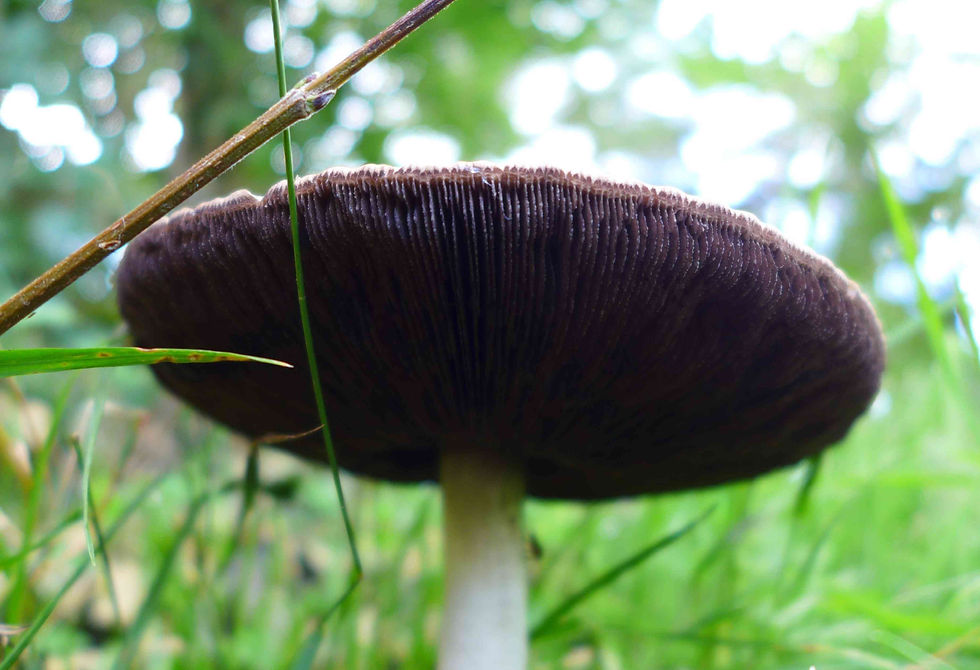
This is one you wouldn't have for dinner. It looked almost like an Agaricus at this stage but was actually a Destroying Angel, a nasty toxic beast.
Frank, a neighbour, is an entomologist: an expert on insects. Hoverflies are his greatest joy. He revels in all the new bug life that he discovers. We don’t know what we’re looking at but love the motorway hum of wild bees in the willows in earliest Spring. The wood and the wildlife it supports is a source of constant joy and wonder.
During Covid lockdown walking was a release for many of us. Starting from my backdoor my aim was to find a new route every day and, ideally, to get lost. I tried to follow footpaths but sometimes that calls for secateurs and the willpower of a seasoned Marine so I’d often take the easier well walked paths of the sheep and the badgers.
When I really wanted to find myself the OS phone location button never let me down. When I’d walked myself out my trusty pal Col would pick me up in the car. It’s a long walk back up Hen Allt.
By the end of lockdown my feel for, and love, for where I live had deepened.

The top of Hen Allt August 2026. Photo by Jack

Can you spot the leveret? 5 of us walked past it but once the 6th person has seen it it was impossible to forget it's brown eyes watching us. Had the grass been green and fluffy I doubt if we would have spotted it. Photo by Jack or Eve
Today, in the midst of this furnace summer, the hottest summer ever recorded, I set off along our track through Coed Comed, on below the triangulation point and then north, down a bumpy track that was once metalled and is now only passable by landrover.

We can’t remember when it last rained. 8 weeks? 10 weeks? The stream had dried up by the end of May. The ground is dryer than we have ever seen. We are not as hot in Powys as the South East of England but Powys was the first county in the UK to declare drought. The mountains to the west of us take our share of rain.

The grass will quickly green up when the rain comes back.
The grass is parched, crackling, pale gold and silver. The hawthorn trees which were decked out with skylarks in May have crumbling russet brown leaves. Rowan trees are occasional on hilly sheep pasture. The Rowan is our magic protector from witches and evil spirits. A silvery trunk leans twisted across the track. Trees have ways of dealing with drought: new growth is not a thing, they close up their pores, their roots release stress hormone.
This Rowan looks dead. The leaves hang twisted and black, the berries drying leathery. They are too thin and too early for the fieldfare that will flock in from Scandinavia and Russia to forage and feast on them in Autumn. What will become of them? If our magic protector trees are dying then what will become of us? We were warned. Over and over.
The sky is a grubby polyester grey. The air smells of dust. I pass through a streamside field that in Spring was full of orchids. Even the rushes look dead. The bone hard ruts are hard to walk along. The stream appears to have dried up but the green of hazels and alders that run along its course show that the water is still flowing, deep underground. So do the wilted rosettes of dandelions still green in fields of silver dry grass.
Every twenty minutes or so a drop of rain touches my skin without leaving a trace, a ghostly reminder of past times. All these long weeks clouds have ambled past us, sometimes clouds have filled the sky like today but they no longer bring rain. They are sterile. It is as if our world has forgotten how to rain. We’re forsaken and we shouldn’t be surprised. We were told. We were warned over and over. We believed them but took no notice. Maybe it wouldn’t happen. Or not yet. But it was our job to protect the planet.

My usual secret stopping place
It isn’t hot, not mid-thirties hot, just mid-twenties. Nevertheless I am dry and hot. I start to feel faint. I should sit down and drink some water. I really should. But the green mossy roots of the oak trees which have always offered a welcoming perch are dried out and threatening, slatey black dust fills their nooks and crannies. It smells sour. The earth, exposed by the dried out moss, has a granular quality. Yellow clay dust streams out below. If I sat there and accidentally slid down it would hurt, there’d be no forgiving, mossy landing.

I feel old and foolish, forcing myself to stand and drink in the doleful grey glare. The old oak tree is the survivor, the moss and fungi that dressed it have withered but the oak leaves are still green. The hazel beside it is dried out and its leaves clatter and crunch underfoot.
Last week, for a few days, you could smell smoke. It was scary. Neighbours phoned each other, even if they hadn’t spoken for years. By day two there was a whiff of plastic in there too. It was coming from fires to the south in Bannau Brycheiniog, the Brecon Beacons: near Llandrindod: outside Newtown. Then the wind direction changed taking its toxic load east. The local fire service are heroic, out on call continuously working long hours in very tough conditions aided by farmers who plough in firebreaks and bring water.
I can see the slide and glisten of the river below. It hasn’t dried out then. It’ll be the same as ever. It'll be a green oasis.


That’s where my jumble of islands is. When I get there it’ll be soft and green and the water will run softly. I’ll swim. I’ll get in at the bridge and float down to the islands above green cascades of water crowfoot, combed out and caressed by the flow. Little fish won’t mind me suspended above them. I’ll submerse myself until I’m cold to the bone, until my brains are cool and comfy in their carapace and then I’ll lie on the shingle beach in the shade like a lazy lizard.

It looks different this year!
The river bank is dried out to concrete. Marshy dips across this field have to be jumped most years. Not this year. I expected cattle. Sheep can get by with whatever they can get but cows need clean water and plenty of it. There is nothing grazing here today. It has been a hard year for farmers.

The seeding dock is ensuring its own survival. It's a toughie.
A single white egret rises at my arrival. There’s been a pair of egrets here for a few years now. You can see them from miles off. Apart from that only a flock of crows stabbing and working the ground of the field opposite where dried out maize reaches the edge of the cultivation, then the criss-crossed stems of dead Himalayan Balsam, the great river bank invader. That’ll knock it back a bit.
You can see from the odd dry leaf floating that the river has hardly any flow. But there is some. The water is about 3 foot deep here. It flows silently. As it reaches the pebble bank marking the start of the islands it starts to ripple and chatter, turning the stones as it runs down a slatey riffle before separating and turning and disappearing down a maze of channels to loop and carve out this year’s island kingdom,
In a kayak the fun is to choose which channel to take. The water is sluggish in byelets, stagnant in dead ends. You try to go for moving water while avoiding that treacherous channel that disappears merrily behind an island, plunges you through a curtain of dropwort and hemlock, storms over a natural weir and then thwacks you without mercy into a “shredder”, a barrier made of fallen trees, brush and twigs which entraps you while the water streams through. You don’t really get to choose, the water does.

This is a wild watery island kingdom offering vengeance or unmapped promise. Get the right narrow channel and it'll be just wide enough to take you back onto the open river, a sensible sort of river that flows demurely past a farmhouse and the broken concrete weir below.
This year you couldn’t get by in a kayak. You’d have to portage. The water is flowing backwards in some places. The exit routes are dried out and impenetrable. Where the river is fast and shallow it appears clean and sparkly but wherever it runs slower and deeper the river bed is smothered in a grey brown pall. Where usually there would be great plumes of crowfoot weed there is nothing. I have no intention of dipping a foot in this, no question of swimming.
There is no shade. The little strands of willow and alder are leafless. I must at least sit down. The steep curves mark out an older deeper river. Where it flattens out the shingle is not quite repulsive.

And so I sit. I drink water and eat a beautiful sweet date that has come all the way from Palestine. I start to collect fine round pebbles according to size and shape. The river has already graded them in diminishing size.
In among the pebbles are decorative shards of domestic china, hunks of sturdy stoneware agricultural pots, tiny dewdrops of worn Victorian glass, fragments of earthenware crocks with thick cream and brown glaze There must have been at least one habitation here, but I have never found where.
My memory dredges half remembered snags of poetry. The Wasteland. What an old misery T S Eliot was. Sitting in his bank-clerk world how did he know of the delirium of dry grass singing, stumbling in cracked earth. “Here is no water but only rock. If there were water we should stop and drink…sweat is dry…here one can neither stand nor sit.”
How can my tired brain that can hardly remember yesterday, dredge poetry from so many years ago? Who asked T S Eliot to inhabit my brain?
I can sit. And after a while I can lie down. It may be hot but who needs shade when there’s no sun? And, it turns out, I can sleep.
I wake from a deep dreamless sleep some hours later. Partridges are peckelling all around me, industriously. It’s all they know to do. The smell of water has brought them down from the shoot’s nursery cages in the dusty woods above. They make a noisy business of escaping when I sit up.
T S Eliot has, thank goodness, gone back over London Bridge. “The nymphs are departed” taking their sandwich wrappers and beer bottles with them.
I have, I realise, kayaked to and slept on another island. Another for Aban.
Number 65.
I phone Col and ask him to rescue me. As I pick my way back through the islands I find a tiny pond sheltered by stands of dying water dropwort. This cup of water stands well above the main flow. Whatever is there was there before the drought.
A frog the size of a thumbnail swims the breast stroke across it. He has an innocent confidence that the rain will come, and lots of it. Tiny slithery fish flirt and dart on important business among delicate electric green plumes of crowfoot. Same family as buttercups. It’s not a long lived plant. Just a couple of years. But what it does is to clarify and maintain the balance of the water. And here it is, doing its job.

We have a job to do and maybe we will do it. It’s not the end of the world. Yet.


Comments