Oronsay and Colonsay
Updated: May 16

I start with a health warning. If you come to Oronsay please tread lightly, if at all. It could be that you don't need to come at all. Though it is a little miracle of an island.
It is 7000BC and the Mesolithic tribes come and go in their dugout boats. They were not the first but they left their mark.
It’s 563AD and St Columba steps out of his curragh onto the wet sand of Port na h-Atha on Oronsay. It’s his first landfall after leaving Ireland. His plan: to found a monastery out of sight of his homeland. Behind the beach Beinn Orasa, Oronsay’s highest point, is Càrn Cùl ri Èirinn ‘the hill with a back to Ireland’. Columba founded a chapel here but still, on climbing the hill, felt too close to Ireland. He travelled on until he reached Iona. And the rest is history.
It’s 1984 and Ike and Frances Colburn, in Chicago, are flipping through a copy of Country Life magazine when they see a for sale ad for a Hebridean island. Its name is Oronsay. “I hadn’t thought of buying an island” Ike said later. But, luckily for Oronsay, they did, sight unseen.
It wasn’t till they set foot on the island that they discovered what they had acquired.

Not just an island but one of the most important Mesolithic sites in Scotland and the ruins of an Augustinian Priory with a 15th Century High Altar and High Cross. The cross, carved out of a single stone, is sister to the High Cross at Iona. In the grass among the ruins were the abandoned remains of what had once been a world renowned school of ecclesiastical carving covered in green slime and mould.

Oronsay was fortunate in its new owners. They set to with energy and sensitivity to restore this beautiful tiny place. They were especially qualified for the job: Ike was a renowned Ecclesiastical architect. Ike has now died and Frances has entrusted the island’s management to the RSPB.


Oronsay Priory was established by John 1, Lord of the Isles in 1325. The two effigies were likely brought to the island in the 14th century. The Oronsay School of Carving was led by Mael Sechlainn O Cuind who came from the Iona School of Carving. There are some distinctive Oronsay features: the trailing stems of plants threaded across the carvings, the use of a singular tri-lobed leaf. The great High Cross, carved from a single stone, is a sister to the High Cross at Iona. We can be grateful for the care and sensitivity the Colburns brought to restoring and preserving this unique place and to their generosity in allowing us to share it.
If you step foot Oronsay please tread carefully and with great care.
This island is a remarkable place where the some of the finest of our human and natural history has been preserved.
The Colburns dedicated themselves to the island, preserving its structural heritage. Frances entrusted the RSPB with managing the land. They farm the island for the good of wildlife. The star birds are Chough and Corncrake, there’s a rare type of bumble bee and a myriad diversity of wild plants. A huge amount of hard work and expertise goes into it.
It’s July 25. Gwen the van, Ethel the boat and Pen the Peregrina have been out and about for a goodly while. We’ve been exploring on Skye and the Firth of Lorn. We’re grubby and quite tired but ready for more.

The wind forecast is mediocre gusting horrible. Not bad enough to send me running for home but not good enough to allow for any ambitious paddle plans.
I’ve decided to take a gamble on the next ferry out of Oban being for Colonsay. God is on my side. The Calmac man waves me into the last minute loader queue. There’s just enough time in hand for a quick whizz round Tesco to stock up supplies.

In a perfect world I would prefer to link the islands together with kayak crossings. Jura and Colonsay are not that far apart. Even Mull is only 14km away. It would be fine to be able to wander. But the weather is imperfect and the Oban Colonsay ferry is a fabulous compromise. A great lump of 60s grandeur with empty lounges and big square salty windows.
The view of the Garvellachs in the early evening sunset pulls me in. What a lucky life I have had. So many journeys. I had already circumnavigated Colonsay and Oronsay, in 2016 with Roger Wild, Alan and his daughter Victoria. On this trip I want to explore the interior of both islands.

My very own magic camp place with the Paps of Jura smiling back at me
On Oronsay I find a long wide shelf of a beach backed by dunes and marram grass. Pulling Ethel up I release myself from the rubbery wet paraphernalia of kayaking and promenade. I want to find the perfect tiny campsite on this magic beach. I’m in no hurry. I don’t intend to camp on the grass above the beach. That’s bird land, even in July when the ground nesters should have fledged.
The water is clear and clean as glass, silver shell sand bounces the light back to me. Lettucey fans of weed ripple in groves. Silver slithers of tiny fish stream in and out. Tiny crabs are on patrol. Fierce! For little fish there’s safety in numbers. The shallows are their home. They turn away as if they think with one mind. The sea beyond is very deep and teems with the bigger fish who would munch them up.
Still glistening wet from the withdrawing tide is a clattery pavement of sea shells: big sun-bleached white clam shells and scallop shells: charcoal grey, black and creamy pink ridged. I’ve have literally never seen so many. Fine blue mussels. I love their indigo sheen. These were the commonest shells on beaches in my Jersey teenhood. There are far fewer mussels these days. I wonder why? You need low water for the biggest.
Behind the beach the towering dunes are secured by Marram grass. Among the dunes are “Mesolithic Shell Mounds”, marked on the map. They’re really big. There’s more than one. A lot of people must have gotten through a lot of shellfish. I don’t think you can smoke or preserve shellfish. Hand to pot to mouth.
Little Oronsay, 4 kms square, is one of the most important places in Britain for archaeologists researching our Mesolithic forbears. Mesolithic. Way before Christ, people who travelled and foraged. I felt very happy and at home with them. This would be my chosen time travel.
I hadn’t felt at home on Colonsay. It’s an island where it is made very clear that you are to sleep in official, paid-for accommodation or go away. That's fair enough. I can absolutely understand and sympathise. But it wasn’t easy, one way and another.
I’d spent a night in a campsite. It was incredibly hard to find, even with gmaps. The man who ran it said hard to find was how they wanted it. They had enough visitors. They didn’t want too many people staying.
I spent one night in a hostel where they lodged me in an outbuilding, alone except for one noisy drunk who apparently stole another visitor’s walking boots from the rack in the main house the next morning. I hadn’t felt cherished. In fact I had decamped to the van half way through the night.

The view from Cowpat Island was glamorous with the moon and the Paps of Jura
I escaped Colonsay’s “hospitality” by camping on a tiny Cowpat of an island with only passing geese for company.
The kayaking was superb though, hiding from the wind on the east side of the islands.
On my Oronsay beach I felt I could stay forever, getting saltier and crustier by the day. And when my Tesco’s supplies ran out I’d happily switch to foraging and a bit of fishing. Most of the fish bones in the middens are saithe, a type of pollock. Now they’re easy to catch, they practically beg to become your supper.
The archaeologist who is the authority on Oronsay is Sir Paul Anthony Mellars, a Cambridge professor of prehistory and human evolution. He excavated the shell middens 7 times. What a lovely life mixing Cambridge and a Hebridean island.
“What’s so fascinating about the Oronsay middens” he said “is that they date from a time when people were on the point of moving from being hunter-gatherers, or hunter-fisher-gatherers, to farmers. These heaps of debris give us a glimpse of lives at a time of transition.”
Limpets make up the majority of shells found in the Oronsay middens. Why not Oysters? Scallop shells make up the greatest number of shells on the beach today. Most people would prefer a scallop to a rubbery limpet. Is it that scallops have increased since those times?
Mellar homed in on the fact that the mussel shells are large and flat, indicating that they were harvested at low water on Springs. We’re not at Springs yet so I won’t get to see what shells emerge at the lowest water. That’s the time for razor clams, another tasty treat.
The spacing of the 5 middens on Oronsay, around a mile apart, suggests to Mellar that these people were coming periodically to harvest shellfish, predominantly the limpets, leaving long enough in between for them to regenerate. And this way of thinking is close to “farming”. They were “thoughtful foragers”, part of a historic transition to becoming farmers.
There is historical evidence that one social group may have travelled seasonally between Oronsay, for seafood, and Islay for deer. There are deer bone tools in the midden, though deer have never been found on Oronsay.
Mellar argues that our Mesolithic ancestors did eventually settle here, intermarrying with local people and developing a new type of farming that yielded more satisfying forms of protein, like mutton and beef. "These heaps of debris," Mellar wrote "give us a glimpse of lives at a time of transition." Link to more below.

You can’t go to Oronsay without visiting the Abbey. The walk across from my beach was short but challenging. The wild flowers had me stopping every few yards. I watched my feet hopping from rocky outcrop to tufty reeds until I reached the safe haven of the farm track where I knew my heavy hoofs could no longer risk some rare plant or late nester.
The grass is managed for the RSPB by a farmer with a relaxed herd of shaggy cows. Both farmer and cows viewed me for a distance. The special birds here are Choughs and Corncrakes so it was good to be camped on the beach where I could do them no harm. There were quite a few Peacocks at the Priory. They clearly thought themselves special.
I could have stayed for longer, for ever even with maybe just an occasional foray to Islay for some venison and a drop of Malt. But I’m driven back to the 21st century by my smartphone warning me that the impending storms are imminent.

On my last morning I walked the beach cleaning my teeth gathering a pyjama pocketful of perfect creamy pink cowrie shells to send to my sister, Jen. I delay as much as I can. My teeth have never been so clean. But it’s time to go. I have no doubt that this beach, in the wrong wind, would be a surf beach. I don’t want to check that out. I’ll be packed and launched and gone before the wind arrives.


I love the way you make a home when you put up a tent - and when you take it down you leave nothing. There’s nothing to show you have ever passed through. Of course I left nothing, in fact I took away the remains from some family picnic: 5 little yoghurt pots nested together and then forgotten.

Ethel the boat packed and nosing the incoming tide, I walked the silver beach one last time, still brushing my teeth by way of meaningful activity. And that, I realised later, was a mistake.
Launching, I headed south-west hoping to circumnavigate Oronsay. A dark sausage of cloud is rolling towards me like a soft sea wall.
There’s a series of rock-walled cuts that lets you take short cuts between Oronsay and tiny Eilean nan Ron. I start down one enjoying a nosy view of crab life ascuttling below me. A Lion's Mane jellyfish looks out of place, big and menacing but somewhat squashed.
My pleasurable dawdle is ruffled by a disturbance of crashing white waves at the exit to my shortcut. There’s a little rocky roundabout half way along my chosen short cut. I circle it and paddle back to the sheltered waters of Caolas Mor. Paddling solo I don’t take risks.

Less relaxed I work my way past my silvery beach home and cross over to the mainland of Colonsay. The higher the tide rises the less far I will have to carry Ethel and my stuff. I need to waste a bit of time.
I twiddle my way down the secret pretty bays of West Colonsay. Two big posh dogs leapt out through the breakers to me. Sweet collars, blue for a boy, pink for a girl. I was a bit surprised. I hadn’t thought these beaches could be reached on foot. But I was up for a chat. Not so the dogs’ owner who came splashing out after them.
With a look of horror the young man stepped backwards and was sploshed over by the next wave, the dogs going with him. Notwithstanding my cheery hello and offer of help he hauled the dogs back to the safety of his family group who were emerging onto the beach, picnic hampers and rugs in hand, children scamping ahead.
They looked like nice people, posh like their dogs but nice enough. Very clean and co-ordinated in their bright new beach picnic in Scotland holiday clothes. Not at all chatty though. Not with me anyway.
Puzzled, a bit hurt, I paddled backwards out through the surf. I wasn't invited to that party. Would spoil the colour theme. I did a bit of a show off. Exit backwards through surf? That’s not such an easy thing to do! Not that they would reallise. They're too busy pretending I'm not there: "We found such AMAZING beaches, all too ourselves. Like the Caribbean!"
Taking my time to work into every nook and cranny I chuntered back to where my van was parked up. Even at high water this was going to be a good half mile walk over the mud flats. I was suddenly exhausted.
As I unpacked Ethel’s holds into IKEA bags a group of young men squished out across the mud flats. “Come on Miss! We’ll get you sorted! Can't have you carrying your canoe back on yer own” In minutes everything had been run back to Gwen the van.
“Now we’ll have to go. Are you sure you’ll be ok? We’ve got to bike over to catch the ferry. Do you know there’s a storm coming? All ferries tomorrow are cancelled” Thick, warm Glasgow accent flowing straight to my heart. The best of the very best.
It’s heaven to sit in a good upholstered car seat after you’ve been camping for a few nights from a boat. And extra special when everything has been carried for you when you actually were very tired even though you never would have admitted it.
Then I catch sight of myself in my rear view mirror. I am sunburnt and crusty with dirt and sand and sun protection cream. I have thick salted straw hair that stands upright in a tufted tangled spiral held up by a grubby pink sock. When did I do that? Add a dash of charcoal from last night’s a fire and a few mementos from breakfast. Wildest of all my mouth is ringed like a clown fish with startling white toothpaste.
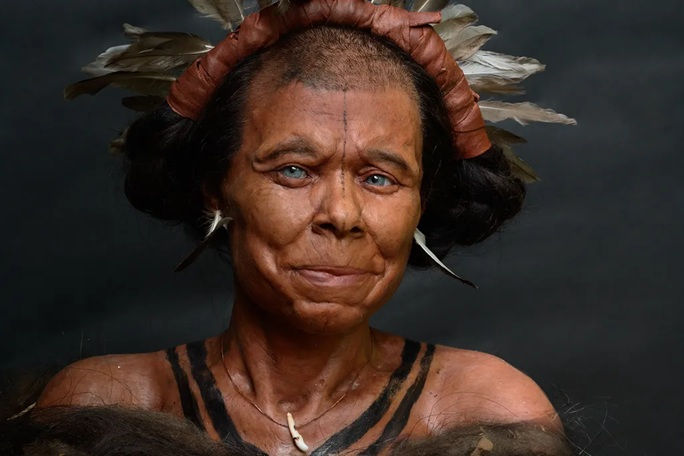
Channelling my inner Mesolith?
So…so this was why the tourist family, and even their dogs, had taken flight.
But those beautiful young men who risked missing their ferry to help me, they were so perfect in their decency in their kindness. A million blessings on them.
Only one island circumnavigated this time, little Cowpat Island, but three islands slept on, Cowpat, Colonsay, Oronsay, making £31 for Aban, the charity that enables youngsters to find adventure. And Oronsay was my 50th island. In my notebook I wrote "The most beautiful island this year. Silky sea, until it wasn't." It suddenly feels, maybe for the first time, that 77 islands is achievable.
For more on the shell middens on Oronsay follow this link


Comments