Slate Islands

Belnahua sunset with Alan Kimber, Andy Ravensill, Amy and Neil. Photo thanks to Andy
People will pay a lot to own their own island, so I’ve heard. The thing about sea kayaking is that you get all the fantasy, the total isolation, the exclusivity without actually having to go to all the angst and bother of ownership.

Belnahua sunset, looking south towards, r to l, Garvellachs, Lunga Scarba and Luing. Thanks Andy for photograph
There’s an island in the Forth of Lorn named on the OS map as Insh Island. As Insh means Island in Gaelic this anglicisation of the name is tautological. But no matter. It’s only a little island, just a bump in the distance as we paddled towards Easdale. It was once home to a quiet eccentric called David Brierley.

Map of the Firth of Lorn from Joan Blaue's amazing Atlas of Scotland, 1654. I like the way the islands are mostly there but not necessarily in the position the Geology Gods ordained
Mr Brierley owned Insh island from 1973 to 2003. He bought it with his life savings for £5000. He was a metal worker, born in Yorkshire, and lived with his mother in Hendon when he couldn’t be on his island. Insh was his kingdom, his escape from the world and in particular from his mother, who, he said, wouldn’t let him meet girls or get married.
Maybe that was all to the good as he was happiest living alone in a hut and doing up his cave home on Insh. Over the years he saw himself as converting and improving his cave and his island, after a fashion. It is hard to imagine many young women sharing his vision. Looking into its shallow rocky embrace Mr Brierley envisaged a sitting room in this narrow dusty space, maybe a space for cupboards in one steep corner. You could see the cave, he said, as “one large bedsitter.”
Nevertheless there is something earnest and endearing about Mr Brierley. His knobbly knees flash in the Hebridean sun as he high steps across the long grass in a BBC interview for Nationwide. Are short shorts really the thing? He looks vulnerable: are there no ticks on the island? His pebble glasses could do with a polish but here he is, master of all he sees, untroubled by anyone's good opinion but his own.

Finished work: he didn't do a bad job either. Mr Brierley's bedsit with hut to the left
Mr Brierley strongly objected to other people, people like us, landing anywhere on the island, let alone camping on it. He owned the island and he found intolerable anyone making his view of the sunset theirs for an evening. Which was quite stressful for him as yachties, boat loads of divers and no doubt kayakers would keep treating the island as if it were public property. He would have found our new legal “right to roam” and camp as well intolerable.
Poor Mr Brierley ended up being ensnared “by social services” and brought back to Easdale. He seems to have made the best of things there whilst maintaining his eccentricity. In the end it was off to hospital, a long way from his dear island home. He gave Insh to the National Trust under the misguided hope that they would protect it in perpetuity. Instead, they sold it for £353,000, quite an advance on Brierley's initial outlay.
It seems that owning your own island is not necessarily good for you. However strong the appeal of living as monarch of your own sea-ringed kingdom, maybe it’s better to have to rub along with neighbours, get on with strangers, fall in love and be rejected, fall in love and commit forever (maybe) and navigate family gatherings.

Mitchell's cigarettes. He knew how to wear the tartan and lean on a fence sure enough.
The Campbells of Breadalbane were more practiced at ownership. They were the leading family of Argyll. Hugely wealthy, used to power, in no way averse to capital investment and commercial exploitation. They owned all of the islands and much besides. It didn’t turn their heads. Unlike poor Mr Brierley they were expert in making profitable marriages and “exceptional in their procurement of land and property, expanding into the lands of Finlarig, Glenlyon, and areas of Argyll and Perthshire.” (Scots Clans website)

Easedale from above after the Campbells had made their mark
Under their ownership whatever wealth the islands had was going to be exploited. And it was. The Slate Islands were hollowed out, literally. The bedrock is Dalradian Slate, the name recalling the ancient kingdom of Dalriada. Slate gives itself to shaping and working. Slate from the islands had been exploited since time immemorial, gathered up and used just as it had been from Neolithic times. Sitting on any Slate Island beach surrounded by flat lozenges of rock the impulse to stack and construct with it is hard to resist. Or indeed to skim it. Easedale today is the place to come for the annual World Skimming Championships.

Slate pool. Photo thanks to Neil
The first mention of quarrying in the islands was by Dean Monro in 1554. The Breadalbane family came to own the islands in the late 17th century and started commercial quarrying by the early 18th century.
Slate was commercially quarried in Seil, Luing, Belnahua and Easdale. Once pumping machinery had been introduced the slate could be quarried to a depth of 250 ft below sea level. Thanks to quarrying Eilleanbach, which had been an island in Easdale Sound, became forever conjoined with Sleit Island by the tipping of waste, a flat man-made village backing on to a quarry with its own row of miners’ cottages. The hollowed-out rim of the island was largely erased, swept away by storms.

Workers on Easdale. Photo courtesy of Easdale Folk Museum
By 1880 Easdale was producing 5 million roof slates a year. They were exported all over the world, even to Novia Scotia which the family also owned. Oban was built using slate from Belnahua. The island was leased to the Stevenson family for that purpose. They also built the Fladda lighthouse on the South West corner of the island.

My tent below a slidey pile of slates, once someone's roof maybe. Photo by Neil
Then came the great storm of 1881, flooding the quarries on all the islands and sweeping sea walls and infrastructure away. In Belnahua the quarries were flooded, infrastructure was destroyed and all the little miners’ cottages were flooded. Children were tucked into the rafters to keep them safe. It’s lucky the roofs didn’t get carried off. The howling and rattling of the wind over the roof slates must have been terrifying. Some of the cows that grazed the island were swept out to sea, poor things.

Aerial view of Belnahua, hollowed out. Photo Wikipedia
The quarries had by then already been sold on to various private owners who reinvested and rebuilt the industry with varying levels of energy. But change was coming, the Welsh slate industry was growing, clay tiles were gaining popularity. The first world war saw many of the quarry men enlist and many never came back. The death toll was heavy on the men, the industry and a way of life.
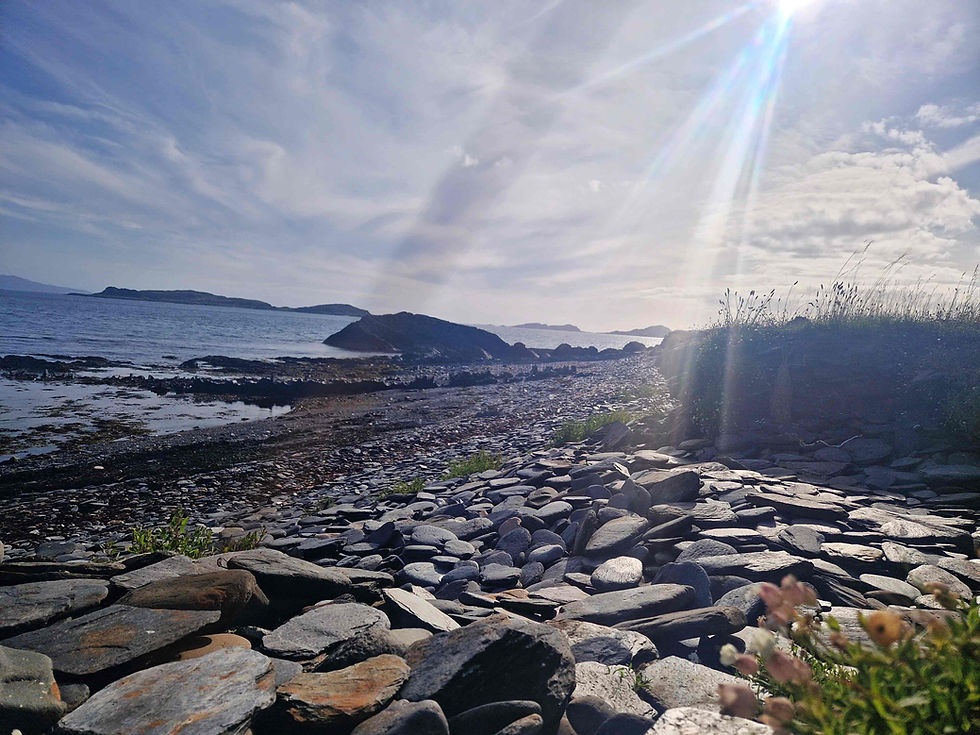
Belnahua beach head. Photo thanks to Amy
As you land at Belnahua the first thing that fixes your gaze is the slate. On the South side of the island these are uniformly round, studded with pyrite, rising in graded sizes up the slope of the great storm beach. Climb up this slope, through the remains of a massive sea wall and onto the island and you are lost in the melancholy romance of the ruined cottages. They are sturdily built, standing like lines of little barracks. Behind them the great lagoons created on that night in 1882, populated unexpectedly by quiet flocks of ducks and geese. Before the storm these lagoons would have been deep pits with all the drama and activity of mining. The apocalypse came and went.

Little barracks in the sunset. Belnahua. Photo by Neil.
Anyone with a heart will fall to wondering how life was for the people who lived and worked there. This was an island where the ground was too poor to support allotment gardens despite all the good soil that was brought in as ballast in the slate boats. There was a well but it wasn’t adequate for the needs of the island. Water was imported, typhoid too apparently.

Birds rising at the edge of Belnahua. Photo thanks to Amy.
The sea around Belnahua is lively and the islanders were reliant on boat traffic for almost all necessities. There must have been times when nothing got through. On Fladda the Stevenson lighthouse marks hazardous shallow reefs. There were shipwrecks even so.
One commentator has compared the life of the miners and their families to slavery. My own feeling is that this commentator hasn’t thought enough about how slavery was. Douglas Gillies, who was brought up on the island, returned there in 1939 to walk among the ruins. He describes a wild and free childhood, quite rough perhaps, a short childhood where school soon gave way to work. It reminds me of my father’s account of his life as a child in rural Bedfordshire in the 1920s. One difference was that Douglas and his friends had whales to watch and the seashore to forage. Douglas was possibly a relative of Dr Gillies who served his community to good effect on Easdale, and Patrick Gillies the author of an epic description of the Firth of Lorn published in 1909.

Possibly the ruin of the schoolhouse which Douglas Gillies said looked over to the cave. On the day oxen were slaughtered there the children were mightily distracted from their school work. Phtoto by Neil.
A folded outcrop of rock dominates Belnahua with a shallow cave within the fold. Apart from that the island is flat. With tents up we wandered out to explore. The barrack-like rows of miner’s cottages kept drawing me back. The slate casings of family life are harsh and unyielding. It’s hard to imagine a woman’s touch among these walls: lines of washing out, children playing, babies taking the sun. The ruins have stood up well considering the roofs caved in perhaps a hundred years ago. There’s no sign of the tram tracks and slate wagons, few metal cranes, virtually no relics of pumping or lifting gear. Some will have drowned in the lagoons and maybe the house slates and industrial metal were salvaged?

Moorings at Easdale. Photo by Pen
Belnahua’s houses started to make sense when I visited Easdale for the Folk Museum. The museum has rightly drawn awards for excellence. It’s a fun visit using the ferry and stopping off for an excellent meal at the café. Most evocative are the rows of houses brought to life, rendered and painted, a pair of wellies left by the door, a child’s scooter abandoned on the grass, the smell of toast and coffee in a mizzle of rain. And again on Luing, thriving happy communities and those same rows of cottages brought alive around the black still waters of flooded workings and a sliding backdrop of slate.

Luing. They're digging up the road to install fibre optic cable, lucky things. Photo by Pen
Easdale was the richest in slate deposits and was the centre of the industry for three hundred years. The last shipment of slate from the island was made in 1911, the last from Belnahua at the start of WW1, Luing carried on until 1965 despite only being connected to the mainland by ferry in 1963.

On Luing ferry tickets/titbits were collected by this little fella. Photo by Pen

Van camping above the beach and below the slatey cliffs on Luing. Photo by Pen
When we started out from Eilleanbach it was just me, Alan and Andy. We pottered southwards down the coast of Luing and, finding no inviting camp spots we cut straight across to Rua Fiola at the north end of Lunga.
The water in the Firth of Lorn is fast and complex but we were on slack, or near enough. Even so there were characteristic mini whirlpools, nothing to worry you but quite eerie, wider shiny slithery still slabs with frills of white water running down the side, little currents and eddies that swivel you round and can’t be foreseen. It's frisk at a fun level.

A hundred years of expertise between these two. Alan and Andy. Photo by Amy
The next day we watched sailing boats racing for Oban with the wind and flow behind them. They were having the best of days, especially those local competitors who knew how to work the eddies. Amy and Neil caught up with us. Lunga and Scarba and Belnahua were there for the taking.

Amy finds a playspot between two islets on Lunga. Photo by Alan
“I think this is my favourite area to paddle” Alan decided one evening. “There’s so much to choose from.” Maybe this is the best fun in the world. A bit of paddling. Sometimes a sea river between islands giving a chance for a bit of a surf. A lazy woman’s feast of wildlife to share time with. Time to explore, time to share a wee nip before sleep. And time to enjoy possession of an island each night without any of the stress of ownership.

Alan and Andy getting ready. Pen playing about. Photo by Neil
Standa island in the Mull of Kintyre is for sale right now. Two slipways and a helipad, a flock of sheep and some deer. Lots of ticks. A snip at £2.5 million. Not for us. Making a new island yours for the night every night, messing about in boats with the very best of friends, leaving it all behind in the morning without leaving a trace, that is wonderful indeed.

And yes, there were lots of otters on Luing. Photo from Free Pix
On this trip we paddled to Luing, Rua Fiola/Lunga, Scarba, Belnahua, Easedale and Seil. I paddled round Fladda and slept on Rua Fiola, Scarba, Belnahua, Seil and Luing. So I will donate £41 to Aban, the wonderful youth charity that supports disdavantaged youngsters to find strength and adventure outdoors. If you would like to support them too you can use the donate button at the top of the page. You can also support Aban by sharing this blog on social media. Thank you for reading and best wishes for today.
Thank you to Andy Ravenshill, Alan Kimber, Amy Goolden and Neil Buckland for so many wonderful photos. I was spoilt for choice.


Comments