Soay

A Basking Shark, photo thanks to Scottish Field
The entrance of Soay Sound. Ethel the boat and I are floating on a silver sea. Just us. Wrapped around us the incomparably beautiful Cuillin mountains.

The OS map of Skye is so enticing
Yesterday, all day, hour after hour, we were on the motorway. The same drone of the engine at 70mph, the same hiss of tyres. Three, sometimes four lanes of little tin boxes each carrying its own little crate of humanity, boxed up and going somewhere. When I have the mental bandwidth I make up life stories for the people encased just feet from me. My tin box, Gwen the Van, is dark shiny grey and covered with silvery scratches, like a Risso dolphin.
Every three hours, I take a break.
I’m on cruise control. In rotation I check: wing mirrors, rear view mirror, dashboard controls. Intense concentration spools the same checks. Smell of stale coffee with a little splash of diesel. My body is held rigid by car seat and steering wheel. There’s no other human activity quite so rigid and de-humanising.

A beer and Ted. Van essentials. Rhum in the distance.
I arrive at dear old Mallaig witless. Have a beer, with bear. Sleep in the van, ready for the ferry in the morning.
Next day I’m suspended, sea below, mountains all around and a blue sky above. It’s silent. Smells of salt. The world can be still and so can I.

Cuillins from the mouth of Loch Scavaig.
In front of me, close enough to touch, as close as breath the silver curve of a whale’s back rises. Shirrs the surface. Is gone. A breath of a moment and the curve is mirrored by a second back, as elegant and slow as it slices the surface, but little, about as little as me.
It’s a moment of breathtaking ecstasy. Every agitation of the world subsides.
Then a shiny black comma, a seal’s back rises and a curious clown face, big eyes and whiskers, smiles back at me with cor blimey surprise.

A Minke rising so softly. Scarcely a ripple.
I’d been having a bit of a fidget: should I land at the head of Loch na Cuilce and walk along Loch Cuiraisc? I'd planned to walk, wrapped round by the Cuillin ridge but the tour boats out of Elgin will be offloading their crowds. It’s been a tourist spot since Victorian times. Or shall I head up Soay Sound for the headland of Rubh an Dunain?
I’ll follow the whales up Soay Sound. No question.
I wonder what it’s like down below me. There’s a lot going on, that’s for sure. The flow in the sound is constant, running continually westward up to 1.5 knots on Springs.
Whales are the super tankers of the ocean. My whale can move fast down there. She can plunge so deep. Does she murmur soft chat to her calf? Her full call, should she make it, is as loud as a jet plane take off. But some whales know to whisper to their young lest they attract danger in the form of the killer Orca.
What does my whale notice with her tiny whale eyes? Does she experience joy? She might. Does she see beauty in the undulating coppery kelp forests? Maybe. Does she perceive the lives of the little beasties skuttling beneath her on the forest floor? Doubt it. That's for Disney.
Like me she breathes air. Like me she gives birth to live young, and cares for then till they're "grown up" and no longer need her. She minds her business and just sometimes comes close enough to feel her. That’s all I know.
I spent intensely happy childhood hours floating in a rubber inner tube tethered to my parent’s boat watching a magic underwater world in the China Sea. Shoals of neon fish moved in underwater murmuration above pink coral. Tetras, clown fish, angel fish and big wavy sting ray. I don’t think that water is so clear now.
I’m happy to keep the world beneath the surface skin of the sea as a secret place where my imagination can still go. I get just a glimpse sometimes when the light filters through bronzey kelp. I don’t have to know everything.

This is what I do know: this whale is a Minke. She will be over ten years old to have a calf and she can live to forty, maybe even fifty or sixty years. She’s nearly 30 foot long which makes her twice as long as my boat. She will have carried her calf for at least 10 months and she could increase gestation for up to two years if conditions call for it. Her calf will be quite new judging by the length. It will way outlive me I hope.
I can breathe in the moment and follow her whale path, west up Soay Sound. Going with the flow I hardly need to paddle, the island on my left, Skye to my right, out to the headland at Rubh an Dunain.
On the Ordnance Survey map fixed under my decklines all the drama is to my right. The brown contour lines crowd steeply down below Gars bheinn, Sgurr Choire Bhig, nan Eag and Sron na Ciche and then drift down to the headland. Allt na Meacnaish, which starts its journey in Coir' a' Ghrunnda, below Skye's highest peak, Sgurr Alasdair finds it's way to the sea here. Further along at An Leac there's another waterfall and what would be an absolutely magic campsite accessible if a person didn't want to camp on Soay.

In his paper “Skye’s Hidden Heritage, Discovering a lost settlement” Marine Archaeologist Dr Colin Martin describes Rubh an Dunan as “remote and inaccessible.” But, he says, “when the sea was the main highway this was a key location for settlement, a dynamic hub of human activity.”
The sea path is the way to go to Rubh. It always has been. I'm on it. The first Mesolithic wanderers were thought to travel in dugout canoes. Their boats were a similar length to Ethel, though wider and, I would think, considerably less seaworthy. I can't really imagine them doing a long crossing.

Mesolithic dugout canoe made from a single Scots Pine. National Museum Denmark
Eve and I did set out to walk to Rubh an Dunain from Glen Brittle campsite a few years ago. We got waylaid. We stopped to watch eagles, sitting with our backs to the great stone wall that crosses the headland at Slochd Dubh. If we had crossed the wall and followed the path we would have been walking through one of the most remarkable places in Scotland, mysterious, largely untouched, loved and revered as a living museum, a monument to nearly 8000 years of continual settlement.

Mesolithic axe heads. Postcard from National Museum of Scotland
Axe heads have been found here from Mesolithic times, 6,000AD. The people that left these would not have made a fixed settlement here, they were nomads taking advantage of the sea routes that opened up after the ice age. Similar tools have been found at Kinloch, Rum.

Neolithic Cairn at Loch na h-Airdre. P Leedell
Sometime in the Neolithic period, between 4900 and 2000BC a fine chambered cairn was built here, just above Loch na h-Airdre. It's still here. The ancient dressed stone is crisp and bright, decorated by electric green ferns. When the cairn was first excavated in the 1930s bodies were found. It was a burial place of a design found from Spain to the Shetland.
If the Mesolithic axe heads suggest that we have, since earliest times, travelled to trade, then the shared traditions of burial cairns suggest that we have also travelled to learn from each other, with an open mind, picking up ideas like dogs collect fleas. May this continue.
The Bronze Age dwellers at Rubh’ an Dunain left a smaller burial cairn and visible ruins of round houses and ancient field systems. These people were no longer transient. For many hundred years they had been settled farmers and fishers. By now they would have discovered the skills to stitch leather and join planks in a waterproof way thus greatly increasing the sophistication of their boats. The headland was now in continual occupation.

Farm buildings at Rubh' an Dunain. Skye's hidden heritage
The great wall is part of a Dun, at the end of the land was part of a bigger structure built during the Iron Age, between 800BC and 1000AD. This wall was honeycombed with smaller cells at least one of which was used for smelting iron and as a workshop. I had looked up to it from my kayak. It remains magnificent from the sea and must have looked extraordinarily powerful from way out to sea when it was fully intact.

Rubh Fort, photo by Richard Dorrell
And then there’s the Viking Canal and Harbour. The canal was built in the early mediaeval period to link the sea to Loch na h Airde, almost dividing the headland. This feat of engineering made Rubh’ an important maritime centre for hundreds of years. There were dry docks at the sea end of the canal, a system for maintaining water height within the loch, and stone-built quays for mooring and unloading.

Viking stonework for the canal. Photo thanks to Digital Scotland
In 1995 local archaeologists found timber which they believed to be the cross beam of a Viking style clinker-built boat. It was carbon dated as being from around 1100AD. Dr Martin and others passionately maintain that this now remote headland was probably “an essential element in the subsistence, security and management of sea craft, and the projection of power among a succession of maritime communities for centuries, if not millennia.”
Dr Martin believes the headland was part of a chain of communication. From Rubh’ your eye is drawn naturally to Rum and Eigg. There’s something like a magnetic pull from here to the Small Isles. By kayak it is a great day’s paddle. To get there by car would mean a long, tedious drive and several ferries.
On Eigg, 27 kilometres to the west there is a similar maritime development: a former lochan which was the harbour, with a shingle gulley leading to the sea where the end pieces of a clinker-built boat were found, in shape distinctively Norse, carbon dated to around 1000AD. Local tradition is that this lochan was used by the Norsemen as a winter harbour for their boats, the boats being drawn up the shingle gulley.
Martin believes that there was a string of beacons linking Rubh’ an Dunain and Thalamh Sgeir on Eigg. Local tradition has it that there was always a watchman at the beacon and that it was so important a means of communication that if the watchman fell asleep on his watch the penalty would be death.
Asgall was the first Viking Lord to stay here. The MacAskill Clan were the sons of Asgal who remained, as beacon watchers and farmers, "tack men" to the Macleod family until the mid-19th century. Their field walls and farm buildings are still visible, you walk across them. What brought their tenancy to an end was a story that is emblematic of the Scottish Highlands and Islands: the Clearances. Poverty and famine on the one side, greed on the other. The last Macleod left for Canada in 1847 and the last tenants in 1854.
So this is the story of life on Rubh’ an Dunain a really quite small headland, now deserted.

Ruins of Victorian farmhouse, Skye Walks
Today I'm hoping to find the entrance to the canal and paddle up it. Although I’ve never met anyone who has done this I feel it might be possible at high water on a spring tide. A friendly tour boat man at Elgol has helped me work out when high water is. From the tour boat, he says, the canal is easy to see.
I pick my way along, tight into the rocks, making the best of my map to work out where the canal entrance should be. I can’t see it from my lowly kayak viewpoint. My tour boat pal has a higher view point. I carry on round the headland to give the water time to rise a bit more.
At the headland the water gets livelier among rocks and skerries. I can see back to Glengrittle where I camped last night. I can appreciate from here how useful a harbour would have been, especially one where the boats could actually be unloaded against a wharf or moored in a dry dock. But out on the headland, as Dr Martin observes is not sea for the unskilled or the foolhardy.
Who could be on this headland without imagining how fine those Viking boats must have looked plunging through the waves, the absolute height of technology of their time. Initially they would have brought terror all along the sea ways. They came, initially, to pillage. The monasteries like Iona and the many hermits’ cells in the Hebrides gave them rich pickings. They came for gold and slaves. Later they came to stay forming a Norse kingdom, the Kingdom of the Isles stretching from Shetland to the Isle of Man.

Looking back to the mountains from Loch na h-Airdre, once a Viking harbour
Eventually I can make out the canal but now I can also see that the water won’t go high enough on this tide for me to paddle in. I could land but the afternoon is drawing on. I need to find a good camp spot on Soay for the night. On my way out I had spotted a good place on the north east: a steep pebble beach with a platform of grass above. It’d be high enough to catch any breeze that’s going which would keep the midges off. Perfect view of the Cuillin.
At home we’ve been making sourdough bread for 20 years from our own home-grown starter. If my partner Col were to kneed out dough at the kitchen table and then squidge it in the middle to give it a waist, if he were to leave it then to rise just a sensible amount then he would have made a very good model of Soay, true in colour and texture. Except Soay has a good covering of bracken and heather and rough grass, a great many lochans and, on the gently risen slopes, sheep and deer.
Soay is in a beautiful setting but is not beautiful in itself. It’s a sensible sort of an island. In Martin Martin’s gazetteer of the Western Isles “The Inferior Islands about Skye” he described Soay as lying within “a quarter of a mile to the south of the Mountain Quillin, five miles in circumference and full of bogs.”
No-one has ever claimed that Soay has good pasturage but this is where those tenants from the Rhundannan and Glenbrittle estate that did not emigrate were moved to as crofters, cotters and landless labourers. There were 150 people living here at one time. In 1841 the tacksman described many of them as “pitiable”, “miserably poor”. He described one young man as “a very useless person though young and healthy,” or “Widow Macrae as “one I would willingly be rid of.” But there was one character who must have been a giant: “The Big Man of Soay, Born 1835. Kenneth McCaskill. Weighed 40 stone and forever wearing a kilt as no trousers could be found that would fit him.”
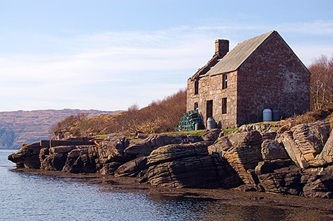
Back down the Sound I can’t resist exploring the northern harbour. I am pulled in by the sight of a sturdy house set gracefully on a curved rock ledge, a natural wharf above a natural pool. In 1942 Gavin Maxwell described this very place: “The sun was hot on the red, sea smooth rock, the tide lapped a vivid intense blue with the transparency of white sand and sea tangle two fathoms down.” A good depth for mooring and unloading basking shark corpses. Behind the house corrugated iron sheds and great rusting hulks of machinery disappear under brambles. This, I discover later, was the site of Maxwell’s shark oil venture.
I can’t find an easy landing below the house at mid tide but there’s enough water to paddle on, under a bridge connecting rock pillars, below high rocks where nets have been hauled up, either to dry or to keep them from floating out to sea. They don’t look like they’ve been there all that long but they don’t look as if anyone plans to use them again. I find an easy landing on the other side of the bay, sliding Ethel up where many boats have been before.

The inner channel is a graveyard of fishing activity. There are fish-crates filled with rusting chains, loops of rope, careful coils of rope, stainless steel fittings left to grow into the mud and reeds. Three hand-made wooden oars are propped up against a fence. Why three? A teapot sits incongruously on a pile of creels. Tea and biscuits anyone? It’s not quite abandoned. Someone could be mooring here at high water after dropping off a moderate to good catch at Mallaig.

Collecting the chain and stacking crates suggests a job abandoned
Pulling Ethel up above the high-water line I fix her to one of the many mooring lines, brew up my own tea and wander along the shore, mug in hand.

Someone, my guess is it’s the same someone that built the house on the rock, built a fine wall at the head of the bay and a sturdy path of stone sets that goes all the way across the waist of the island to the South harbour where the main group of dwellings is. According to “The Congested District Board Files” of 1902 there were improving works on Soay including the construction of this footpath. They made a tidy job of it. I follow the path almost all the way across the island to connect the harbour to the township at Camas nan Gall.

Nowt so forlorn as an abandoned boat
It feels sad. It’s a not-quite place. Not quite a going concern. Not quite a home, not quite abandoned.

Soay does, however, have a good range of plants and biodiversity. The island is for sale right now. Maybe the next owners might want to work on that.
It’s too late now to carry on to my Plan A camp site. The tide has left Ethel high and dry on an oily mud bed. I make my camp on a grassy rock some 5 feet above the water line facing back to the factory house.

I feel uneasy but I think it will do. Could be some good bird life to watch as evening draws in, surely otters live here and surely fish will jump. But nothing. No birds, no otters and no fish. The water seeps out as the tide falls. It feels sinister.
When the wind drops three zillion midges arrive. I dive into my tent and do up all the zips and then remember I need a pee and have to reverse out again putting wellies on against the likelihood of tics and then I’m back in the tent and only a couple of midges have made it in there with me and then I realise I’ve left the water bottle on the rock where I ate my supper and then…I’m asleep.
You would expect midges in July on an island endowed with bogs and lochans. I had indeed expected them but things happen. I’d left it too late to move on. In 1857 James Wood was surveying the area. He wrote: “The Island of Soay contains no attractions of any kind. The midges of Soay, being the torment of this country, the mosquitos of the Highlands….the sharpness of their teeth is too well known and I can answer for the sharpness of their noses. We anchored offshore and yet they smelt us and within a quarter of an hour the vessel was covered with them”. I’m glad I have two zips on my tent!
Inside my zipped-up cell I’m dreaming that I’m in a giant Tesco. Tesco is Mecca for sea kayakers. It’s where we stock up on exciting stuff like tins of anchovies. The lights are blinding bright white and for some reason I’m way down at floor level. I suppose that’s because I’m asleep, in my sleeping bag, in my tent, double zipped in. But there I am in a dream Tesco and the shelves are filled with shiny jars and packets just as they would be and my basket is empty. Treats! I stretch out my hand, take a jar and put it back. It’s labelled “Maggots in Slime”, another is “Eels in Oil”. I daren’t look at anything else. What if you dropped a jar and it broke and they wriggled up and there you are doubled zipped in? It’s the kind of dream that wakes you up, hoping it’s morning soon.
My nightmare was not far off the mark. That night I hadn’t even read about the Shark Oil factory. I didn’t start reading about that until weeks later. So how did I know?
After an extremely wholesome breakfast topped off with excellent coffee and no midges at all I break camp and slide Ethel back across the weed and mud and head northwards out through the mouth of Soay Harbour. This time I head north again towards the mouth of the Scavaig River, hoping to find a place to land Ethel and do some walking before the tour boats arrive.
According to the forecast I could have 12 hours of decent weather to play in. But I might not. Change is coming. As I wriggle up Loch Scavaig the headwind increases. When the wind is in a certain direction it funnels down from the Cuillin in great lumpy gasps.
I turned to assess the effect on the more open water between me and the safety of Elgol. In the course of an hour the sea had chopped up. White horses were forming. If I turned back now I would have a fast if lumpy run home. I might even get there before the ice cream shop closed.
The wind pushes me back into Elgol harbour and my boatman pal comes down to meet me. They’ve called all the tour boats in and they’re glad to see me. “So you saw our Minke then?” he says, “and her calf.” “Yeah”, I say, “Lovely. But how did you know?” “Ah well,” he smiles, “we kept an eye on you. We know how you're getting on. We knew you were fine but we like to look after our visitors.”

Launching from Elgol. Other kayakers, boat trip tourists and a herd of longhorn cattle for company. Good ice cream too if you're lucky. And very kindly locals.
I’m too late for the ice cream stall but his kindness is sweetness enough.
It was not until weeks later that I started to research Soay’s 20th century history. For such a small island there have been a lot of words written. I find I can’t write any. I’ve tried and failed over and over. So I’ll stop trying. These are the books if you care to find out for yourself. I need to come up for air.

I like to arrive on an island free of preconceptions. Reading and research is a quite separate activity. I enjoy that when I get home, often stocked up with obscure local history books from Oban Oxfam.
Maxwell and Geddes stories of Soay stopped me in my tracks. The source of my discomfort and nightmare on the island was confirmed. The way we saw the world in the 1950s was so very different from today. Maxwell was - is - one of our greatest "nature writers". But his "adventure" on Soay was something else. It stopped me in my tracks. He writes with such elegance and romance about something that is, in the 21st century repulsive.
So I’ll finish with a word in praise of Basking Sharks.

Gillian Parker and I on our way to Mingulay to meet a basking shark. Photo by Neil Buckland.
Basking Sharks are as placid, slow moving and enigmatic a creature as you could wish to meet. They’re the second largest fish in the world, 12 metres long and as weighing as much as 6 tons. We don’t know all that much about them. They migrate, they go deep in winter, so deep that we’re not sure where they’re hanging out.
Their fins are ridiculously high, sail like, easy to see when they’re “basking” near the surface, cavernous white mouth wide open to filter the zooplankton that they live on. They have no bones, no skeleton, but a frame of cartilage which makes them lighter and faster to turn. If you feel your ear or the end of your nose then you’ll get the idea of how cartilage feels. Or you could try feeling your friend’s ear, not the soft lobe, the top bit.
Unlike us they are an endangered species and that of course is mainly thanks to us.
A research project called Ceti has come to understand that Sperm Whales have a language far more complex than ours, and much older, ten million years older. These whales combine vowels to make diphthongs to make speech to say things in the same way that we do. Ceti have established that the two main “tribes” of Sperm Whales have the same language but different accents. The research program is now using AI and other modern technologies to see if they can work out what they are saying.
Can we understand what creatures that have such a very different experience from our own are saying? Will their vocabulary bear translation? I’m not so sure. And anyway, despite all our cleverness, maybe we should respectfully mind our business. Their secrets might not necessarily be safe in our hands. We might find something we can exploit. That’s what we do.

The view of Loch Brittle from the excellent campsite at Glen Brittle.
On this trip I slept on two islands, Skye and Soay and circumnavigated two, Soay and Eilean Glas in Loch na Cuilce so I will donate £22 to Aban, a youth charity that gives young people a lasting taste for adventure. There's a donate button on this page. Thank you.
“CETI is a listening project that uses advanced machine learning and robotics to understand what sperm whales are saying.The first phase is to construct a one-of-a-kind large-scale acoustic and behavioural data set to train CETI’s technology to observe whale communication in context and to translate whale-speak.”


An excellent write up , I was captivated by Gavin Maxwells writings so we can talk about this at the weekend and muse over his exploits … he would for sure be impressed with your spirit !