Raasay
Updated: Feb 16

A special welcome to the friendliest of islands. Photo by Pen
Skye is surely one of the most charismatic and beautiful places on earth. Not surprisingly it is mobbed with visitors. The roads are choked with glittering chains of cars and mobile homes chugging through the hills. There is much grinding of gears as endless big box motorhomes navigate the passing places on single tracked roads.

Skye, photo by Eve
The sea kayaker has an advantage. Once we've launched we bypass all this. We can float and skim the magic of this incomparable island. From above Skye is like an octopus: if you include Raasay, Rona and Scalpay there are eight squidgy limbs with protected marine alleyways between.
A kayaker with a van has a good chance of finding a paddle sheltered from the wind. My ambition on this trip was to go where the winds blew me, with no particular plan. I was inspired by St Brendan and his 6th century monks, to peregrinate where God’s winds took me.
When the wind blew me off Loch Scavaig on the south side of the island I hopped from Elgol over the Cuillins to Raasay where I found something unexpected: sunshine! At least two hours of sunshine in which to hang up my kit to dry and air it.

Raasay scrambles up the eastern side of Skye like a stone lizard. It was my first Scottish island kayak expedition, a “club trip” with people who became dear friends: Richard Green, Duncan Smalley, Matt Dunn and Tess. We went up the West side of Raasay, looped Rona and skipped back down the West side. Not a circumnavigation. I have unfinished business.

First Cal Mac with boats. Duncan, Tess, Pen, Matt. Photo by Richard Green
Richard was our leader. I was so nervous about letting him and the group down that I begged him to go without me. Richard, kind man, refused. “Club trips,” he said, “are about going at the pace of the slowest person.” So everyone, even absolute beginners like me get a chance.
We set off up Raasay and Rona. It became obvious how slow I was. Tess, with great tact, gave me my first lesson in “forward paddling”, the fundamental art of sea kayaking. Thanks to her I wasn’t so slow. When we’d crossed the sound to Rona Tess came alongside. “Did you know you were surfing? You like waves don’t you?” I hadn’t realised I was surfing. It felt like flying. It was a first for everything. Sometimes I wish I could start over just to get the thrill of those “first” times.
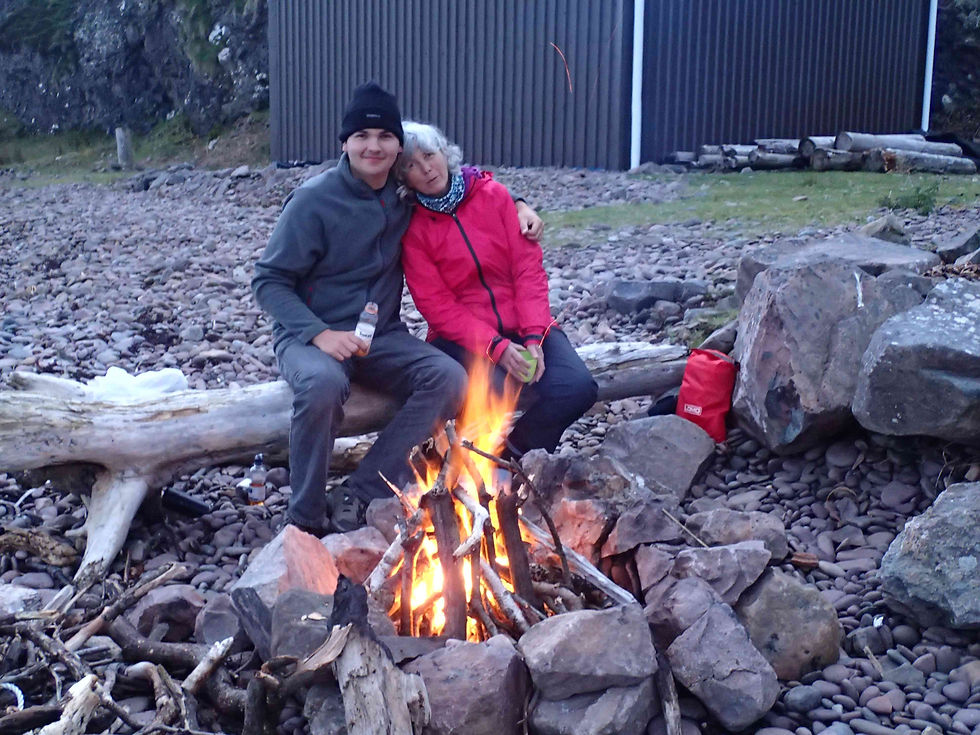
Matt's first ever bonfire on the beach. Photos by Tess

We reached the end of the land. Sea and sky merged, as dark as squid ink. Wind blustered and scurried. Rain drops made a silvery percussion on the dark waters. “That way,” said Tess, drawing alongside me at the point of Rona “that way there’s no land till you get to Greenland. We’re so privileged to be here.” I was thrilled with gratitude just to be alive and yes, to be there in my borrowed boat, thanks to Gill Otto. Rona felt like the most far-flung place on the planet. The sheer audacity.

And then disaster struck. It’s that sort of place. Matt ran out of steam. He just couldn’t paddle any further. We’d been camping for days and every day it had rained. His food rations were a bit heavy on Kendal Mint Cake and low on protein. Matt’s tent didn’t quite cover his length. He had been a bit too cold and a bit hungry and never quite dry for too long. Matt had hypothermia.
We struggled round the headland, Duncan towing Matt, past Sgeir Shuas when we came unexpectedly on some little working boats, cable-laying boats. Richard paddled over and explained the situation and we were directed to a slip on the tip of Rona. As we landed a helicopter hovered down beside us and a smart Land Rover curved down to the head of the slip. Far-fetched and glossy, lit was like being on The Night Manager on telly.
A doctor, almost as good looking as Tom Hiddleston, hopped out and assessed Matt. He decided Matt didn’t need to be taken off by air ambulance and directed us to the Land Rover.
Hunched down in the heart of little Rona, quite hidden, is a low complex of slightly sinister buildings. If Matt had not been taken ill we would have paddled by without being aware of it.
QinetiQ mean anything to you? Me neither. Apparently it’s a private sector company “an engineering partnership strengthened to increase UK defence productivity”. What does that even mean? It “supports the rapid deployment of military equipment to the frontline”. Which accounts for the helicopter and Land Rover, the cable laying boats and the rapid and efficient deployment of sufficient forces to rescue Matt. We were now, incongruously, QinetiQ’s guests.
We were shown into a super warm common-room/kitchen. Very clean. Everything had white labels on, even things that the average three year old would recognise without elucidation: “Toaster”, “Freezer”. Very warm after our camp spots. The only rules were not to leave it without escort, not even for a pee, and absolutely no photographs.

The fridge labels reminded me of Amy's reaction to a French teacher who thought flash cards were an exciting new idea. For a while everything got labelled.
Best of all, the biggest shiniest “Fridge” crammed with goodies like “Sliced Cheese” and “Nutella” for our pleasure. We scoffed with enthusiasm, except for poor Matt who couldn’t be tempted. He didn’t seem to warm up. He’d had enough of rain. He just sat. An hour later Matt was taken off the island with Tess. I was going to miss him, he was a newbie like me

Bye Matt, see you back in Shrewsbury. Photos by Pen

Bye Tess. We'll miss you! From our boats we could take photos again.
Richard delegated me to go with Matt and Tess volunteered to take my place. She was, she said, a better person for the job: an experienced professional nurse with a friend living nearby. She had seen that I was devastated to be taken off and had volunteered out of kindness. “If Richard as leader asks you to do something then it’s your job, as a member of a group, to support him and do what he asks” she explained. “He takes responsibility for us all and your job is to support him in his decisions. But this time I’m better able to look after Matt.” Thank you Tess for wisdom and practical kindness.
Richard, Duncan and I spent a night tucked in on the west side of Rona watching the wildlife and sharing whisky. Next day we circled back through the skerries in Caol Rona and down the west coast of Raasay, hiding from the wind. We were escorted from our Rona camp spot back over to Raasay by a launch which kept just far enough from us to dispel any feeling of friendliness. This also dispelled any lingering impression we might have had that Rona was just any old island.

I think this was Duncan and Richard with Skye behind. It went dark and wet, with squally rain for our paddle back and Dunc raised our spirits (not) by identifying clouds that he said would bring particularily evil winds. Photo by Pen.
Ten years on my unfinished business is to complete the circumnavigation of Raasay by going up the east coast of Raasay Sound as far as Rubha nan Sgarbh at the head of Caol Rona. Kayaking round islands is satisfying. It is an intimate and privileged experience to travel where the land meets the sea. But you don’t get any feel for the interior. This time I also wanted to get my hooves on the ground, to do some walking, talk to people and get a little taste of how it feels to live there.
In honour of Tess I wanted to travel Calum’s Road. Tess told me about Calum when we were on the water. A few weeks after our trip she sent me her copy of the book, “Calum’s Road” by Roger Hutchinson. It was the first, but not the last unexpected parcel I ever received, wrapped in re-used brown paper, from dear kind Tess. A pair of soft wellies arrived a year later: some friends of hers has seen me in flip flops on an island, at that stage unaware of the risk of ticks.

Calum MacLeod, Photo by Wikimedia
Calum MacLeod was a crofter, keeper of the Rona Lighthouse and postman for North Raasay. There was a council maintained road as far as Rubha Crion, but there it stopped. For the people living north of Brochel in the villages of Arnish, Torran, Umachan and the island of Fladda there was a hard scramble to get to Clachan and South Raasay.
The homesteaders and crofters living north of Brochel were, for all practical purposes, cut off from island life. The local community had petitioned many times, unsuccessfully, for the council maintained road to be extended. So Calum set about doing it himself.
He bridged the gap as a labour of love, in his spare time when he wasn’t farming his croft, delivering letters or looking after the lighthouse on Rona. Wielding a spade and his home-made wooden wheelbarrow he took on the task of widening the path and grading the way until it was possible to drive the road in his Land Rover. But he never drove south of Brochel on account of never getting his driving licence.
Calum started in the mid 1960s and finished in the mid 1970s. When Calum started there were 90 people to be served by his 2 mile length of road. When he finished only Calum and his family were left.
One day in 1988, Calum MacLeod, by then proud holder of an MBE, finished his lunch and went outside to carry on with his day’s work.
“He’d had his lunch,” said his daughter Julie, “and went out of the door, but he didn’t come back in for his mid-afternoon cuppa. My mother thought he was busy doing something, or had met somebody and would be chatting. Then she realised that it was getting dark and wondered, ‘Where is he? The cows have to be fed.’ “She took her Zimmer frame and went outside, and all the cows were at the end of the house looking through the gate. She wondered what the cows were doing there, and she looked further round to find my father there, just at the end of our house. He was in his wheelbarrow, with Coll the white collie on watch. I think he had sat down on the wheelbarrow because he felt unwell. We assume it was a heart attack. The family was prone to them.”

Calum’s Road was a must, but first of all, because the weather was mostly good I took to the water. A blue day, dawdling up the sound, with the jaw-dropping view of the Cuillins to my left and the bucolic prettiness of Raasay to my right. Flossy sausages of clouds rolled down from the Cuillins and floated jauntily on the water. Despite the blue skies the clouds had a life of their own, occasionally playfully sucking me in, blotting out the rest of the world. So much beauty is almost tiring. It’s restful to float in a pearly white world with the occasional seabird for company.

Looking back at Skye, photo by Pen
By the end of the day I had finished my circumnavigation and twiddled round two more islands Holoman and Fladday just for fun. As I came back to the harbour at Clachan I deviated back to the Skye side to look at the caves just outside the ferry terminal, half hoping to find myself amongst the dolphin pod that lives in the sound. Solo paddling is made for such meandering days.
I was by Gwen the van, taking my time over changing out of paddle clothes and chatting with a beautiful young woman called Flora. She was frazzled from a day of last-minute preparation for a lecture that she would be giving at a symposium in Glasgow the next day based on her Master’s thesis.
Flora’s thesis considered whether changes that have taken place in land management and ownership since the Napier Commission (1884) have benefitted farmers in the Highlands and islands.
“Has it?” I asked her. “Well not entirely!” Flora exclaimed, surprised to be asked. And then, with passion “No!”
I would love to have been at her lecture, to know why her “No!” was impassioned. Coming from a Raasay farming family she must have particular insight into a question that has defined the Highlands and Islands for 200 years.
In the nineteenth century Highland landowners reckoned that sheep farming and hunting forests were the best prospect for their enormous land holdings and started the infamous Clearances.
Skye was central to the struggle. In 1882, for example, there was the ‘Battle of Braes’ on the east coast. Crofters let their sheep graze on land that had previously been common land, stolen by their landlords. 50 Glasgow policemen were sent to sort them out and were routed by the locals. Some Brae men were arrested and taken to Inverness for trial. They enjoyed vocal support from a “crowd (which) increased to several hundred, and lustily booed the policemen” (The Scotsman newspaper, 21/04/1882, p.3).
In 1883 the struggle spread to Glendale on Skye’s west coast. Crofters’ protests were again met with police action. For three weeks the police were harassed and harried. Her Majesty’s gunboat Jackal was deployed. Four crofters were taken to Edinburgh, where they were again supported by a huge crowd.
By the end of 1886 29 policemen, 250 marines and a goodly number of naval gunboats had come to Portree and Dunvegan to establish a military occupation lasting six months. Boats had foundered on Raasay's rocks. Eviction orders had to be backed up by military who could be unceremoniously beaten back.
Local people must have had such an advantage over the town lads when it came to heather and rocks and tricky sea landings. I can well imagine Flora’s ancestors’ enthusiasm for the fray. The crofters and cottars had been treated with meanness and cruelty for so long. It must have felt wonderful to fight back.
They had been burnt out of their homes, had their rents raised and holdings reduced until they were no longer viable. They were constantly oppressed by the Lairds’ Factors. On Raasay the hunting interests of the Laird and the Factor had long sublimated the Crofter’s ability to produce a crop from their mean holdings.
The government in Westminster started to consider the possibility of revolution. It had happened in France, and, more recently, Ireland. They commissioned Napier to form a committee and report back on how best to proceed.

Contemporary drawing of the Commission at work. Photo Historic Scotland.
You can find the Napier Report in its entirety online. It is extraordinary to be able to read the testimony of local people verbatim, people who did not generally have a voice and who had no power, and no legal representation.
Norman Maclean and John Munro, two delegates from Raasay testified to the Napier Commission that the little bits of poor ground that they had were devastated by their landlord’s game: deer, pheasants and rabbits had free run over their crops. The crofters were not allowed to use traps or dogs or in any way make use of the game to feed their own families.

To make the rent whole families had to toil in the fields; “They are reduced into poverty.” Munro testified. “Since I came to Rona I never saw a place like it. They toil away all spring—men, women, and children—and sometimes I am grieved to see the women, and perhaps I should not speak about some things I took notice of here in public. It might be very unsatisfactory to some minds to see in the public prints that a woman carrying sea-wear might be working at that to-day, and in child-bed to-morrow.”
The ensuing “Report of Her Majesty’s Commissioners of Inquiry into the Condition of the Crofters and Cottars of the Highlands and Islands of Scotland” pleased no-one. Such things seldom do. But, unlike the Commission reports of today Napier's did herald change. The committee of six, despite being drawn from the great and the good, heard far more testimony from the lower classes, the crofters and cottars than they did from the landed gentry and Factors.
Napier’s conclusions seem, at least in part, radical. In the conclusions he wrote: “The severance of the labouring classes from the benefits and enjoyments of property (certainly one of the elements of civilisation, morality, and public order), and their precarious and dangerous condition as dependants on capital and mere recipients of wages, is a question which engages the reflections of those who reason and of those who govern. There is a general desire that the labouring man in every sphere of activity should be invested with a greater share of substantial possession, and be attached by deeper and more durable ties to the soil of his country.” P114, vol 5
The Report marked the beginning of legislation that has, by degrees, changed Scottish land ownership. Starting with the Crofters Holdings Act of 1886 which granted crofters rights like fair rent, fixity of tenure and leading on to, in the 21st Century, Government Acts allowing islands and estates to be bought into community ownership.
Raasay was one of the first. The island came into community ownership in 2007. Community ownership is clearly a challenge. Ownership by committee. I would like to have been able to quiz Flora on how it’s working out in Raasay and why she feels, with passion, that things haven’t quite worked out. Yet. But she was frazzled. She had to catch the first ferry next morning. And then down to Glasgow. “Park up there” she said, after helping me load my boat on my van. “In that gateway. You’ll have a great view and it’s my Dad’s field so no-one will complain. Well no-one would complain wherever you parked up.”
Rasaay does seem like the friendliest and most welcoming of places.
Did I mention that Tess had sent me some wellies? They stuff down into the pointy end of my back hold. Don’t paddle anywhere without them. It works. Only ever had one tick.
Ah, the curse of the tick.
I sat in Gwen the van in Flora’s Dad’s gateway, admiring the view and swapping paddle thermals for pyjamas when I noticed something ‘orrible. Ticks! A flock of about nine of them safely gathered in on my tummy. Little barbarians.
When did you last look closely at your skin? For me it would be around 60 years ago, when I was a teenager and such things mattered. Then, aged 23, after my first baby was born, I realised I had achieved stretch marks! A baby and stretch marks! So grown up!

Oh Jack....but... I had black hair 52 years ago. Bit serious. White/Silvers have more fun.
I can’t say I’ve taken much notice since, ever. I’ve been quite busy. But now I have to look closely. What ever has happened? Our skin is our largest organ. But mine has stretched sufficient to enclose several of me. My skin’s job is to hold me together. It’s the outside to my insides. It does the job. But when did it get so floppy? It has developed a million tiny pleats, soft and silky and strangely riverine. This is not what I planned for. And now, snuggled into the pleaty folds are shiny maroon coloured ticks.

No problem! I carry a significant tool kit just in case. The tick kit, used for the first time on Raasay, has a mirror for 360 degree spy work, some tick repellent that probably doesn't work, glasses just in case, special tweezers, two tiny crowbars that work well on my cat, a disgusting ointment that a pharmacist tells me will get out any tick-bits left behind and a plastic card with a fine cut in it to slide under the tiniest of beasts. If you have good fingernails they are said to work well.
So I settled down to the job of removing my alien invaders, working as fast as I could while there was still daylight. My theory, never before tested, is that you can check your whole body with a tiny square of mirror. Luckily I only seem to have the tummy flock. I kill each and every invader and flick them out of the van window.
Satisfied with my total competence when it comes to tick control I turn myself to sleep and dreams of Marks and Spencers almond croissants, set out on spotless white plates. That’s my idea of heaven.
I may be getting old (76), my skin may have outgrown me when I wasn’t attending, all this and more but here’s the thing: I can deal with tick invaders, I can paddle as well and as far as I need to. I can keep up and sometimes more. This is a good body. I had 4 babies. So it’s well worn, but it does what I want it to.
Some women say that the worst thing about getting older is that you become invisible. I love invisibility. It means I can get on with whatever I want to do undeterred. Like most women I remember vividly the shock of first being wolf whistled. I was 13 or so. I was doing nothing more than walking across town after school. I was working out which sweeties I could buy with the change in my blazer pocket. I wasn’t a grown up, I wasn’t pretty, I wasn’t in any way interested in the workmen who felt they had the right to intrude on my privacy. I wasn't ready for it and I bet that's the experience of most women.
Get over yourself kiddo. The only way out is to get old. And then, like Harry Potter, who was given his cloak of invisibility by Dumbledore. you can wear your invisibility with pride. It’s your Secret Power!
So, dear younger reader, don’t you worry, the wonderful thing about getting older is that no-one notices you anyway and them as do think, quite wrongly, that you’re rather sweet. When in fact you have secret powers! Plus you have tick killer skills.
It can’t last. One of these days, as sure as death and taxes, I’ll get my cards. Everyone does. Bits will fall off. Other bits will stop working. I hope I’ll manage to be brave and dignified though I’m not at all confident that I will. But for now everything is just fine. In particular, I am now a qualified, highly skilled tick killer.
Another day of exploring. Another night in Flora’s Dad’s gateway. The next morning six more invaders are latched on. No problem! Ticks are out and dead, out the van window. This time I use the sliced credit card method. Slightly disturbing but it’s a still day of soft tissue blue sky so I’m off on the water again.
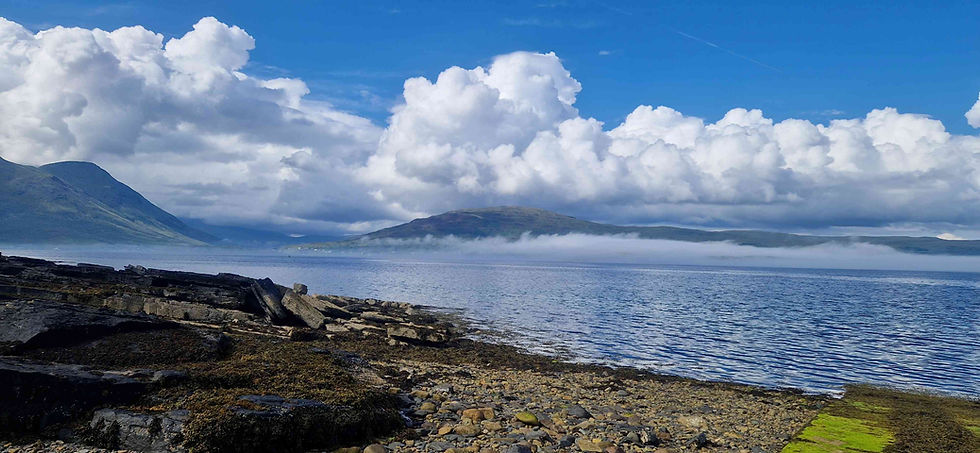
Another day, another puffy play cloud. Photo by Pen
That evening 15, 20 more ticks. They’re all over the place. I can’t count them. My fingertip locates one on my back, and next to it a friend. And then another. I am an old lady defeated. I am blubber. I phone daughter Amy: “Sniffle snuffle sob…ticks!” Cry moan “Can I come over to your place? I’m covered in ticks!”

Amy and Tablo. Amy has acquired excellent tick skills as a long time cat lover. He was a grumpy old fella too!
Kind clever Amy.
Here’s the Amy cure for ticks, my kind, clever, beautiful daughter. (Got that Amy).
“First immerse the ageing mama in a hot bath. This is for your sake as well as hers: after a week camping she is quite smelly. As she is really old she doesn’t realise this. When she is pink, clean and getting dozy, while she is still in the bath, gently turn her removing and killing ticks from every scalded pink acre of aged, wrinkly, venerable skin. Does she realise how wrinkly she is?
“Don’t do her privates. Enough already! She can do her own for goodness sake.
“Remove Mama from bath and make her scrub the tub. Offer a reward of alcohol to ensure good behaviour is maintained. I need it too.
“Hoover everywhere Mama has been. Bag up all her stuff. Offer more alcohol as required.
“Wash everything at 60 degrees C. There’s a good laundrette at the garage outside Oban. Steam clean the whole van before putting anything back.
“Send Mama to local GP. The Practice Pharmacist turns out to be a white-water paddler who takes his lunch hours on the Falls of Lora just below the Health Practice. On seeing halo rash Doctor prescribes 6 weeks of antibiotics. Mama pronounces herself vindicated.

The ultimate in tick control, thanks to the NHS
“Take Mama out to lunch. She’s scrubbed up quite well but seems curiously downhearted. Probably all the excitement. Or the antibiotics. Suggests we go off paddling at the weekend. There must be some islands there she hasn’t done yet.
“Don’t tell her but next day keep an eye out for the ticks that evaded the Hoover.”
Thank you Amy. By the way, when I was walking I wore Tess’s boots religiously with my leggings tucked in. I kept my arms up when walking through long grass. I never sat on the grass. I had taken every possible precaution. These were the cleverest tiniest ticks ever known to humankind.
Don't be put off by my visitation! Raasay is a lovely island to visit. The kayaking is fun but so is the walking. There's no campsite, which is a pity because showers and a washing machine would have been welcome but I only met friendliness when camping from my van. The Raasay Hotel is interesting: it belongs to the island community but is managed by one family as a family hotel and activity centre. And there's a fine, award winning distillery.
On this trip I slept on one island, Raasay and circumnavigated 3 islands. So, using the Donate button which occurrs at the top of each page of my blog I have donated £33 to Aban.
Ticks are actually really interesting. They are highly skilled, resourceful blood suckers with fascinating life stories.
For Raasay, Volume 5 of the Napier Report. You can use the search engine to go to particular islands or entries.


Comments